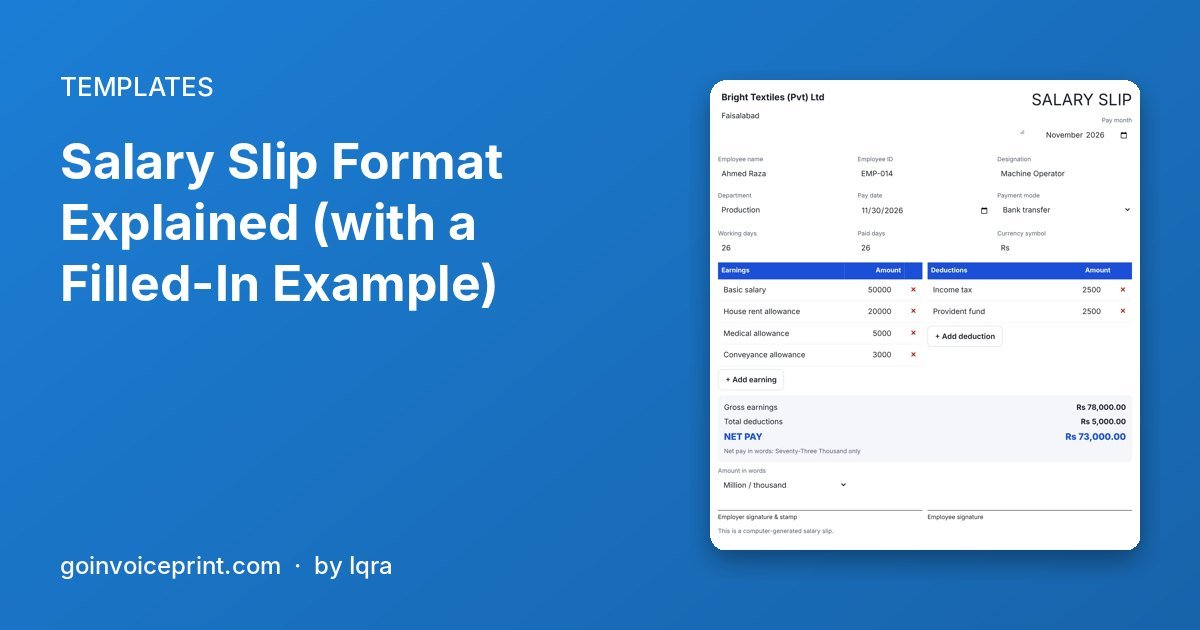
A salary slip (also called a pay slip or pay stub) is the document an employer gives an employee each pay period. It is often needed for much more than the employee’s own records: banks ask for recent slips before giving a loan, landlords ask for them before renting a flat, and embassies ask for them with visa applications. A clear, correct slip saves both sides a lot of questions. Here is what each part means, using a filled-in example for a small textile company.
- A salary slip shows what an employee earned, what was deducted and what they were actually paid.
- Gross pay is all earnings added up; net pay is gross pay minus deductions.
- Show every allowance and deduction on its own line.
- Keep a copy of every slip you issue.
1. Employer and employee details
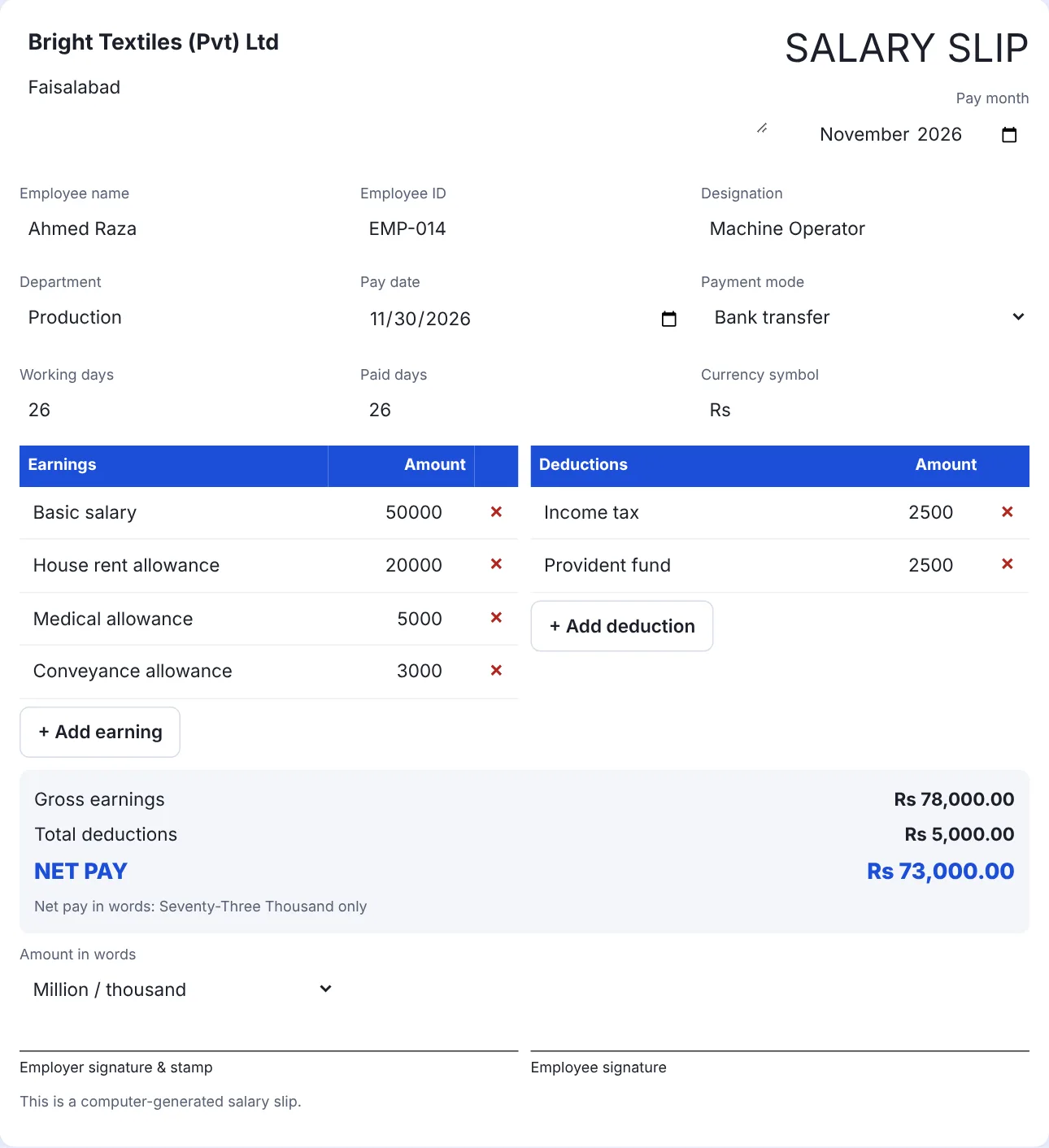
The top of the slip identifies who is paying whom and for which month: the company name and address, the pay month, and the employee’s name, ID, designation and department. Add the pay date and how the salary was paid (bank transfer, cheque or cash). Working days and paid days show whether the full month was paid – useful when someone joins mid-month or takes unpaid leave.
2. Earnings
Earnings are everything the employee is paid before deductions. In the example:
| Earning | Amount (Rs) | What it is |
|---|---|---|
| Basic salary | 50,000 | The fixed core of the pay. Many other figures, such as provident fund, are often calculated from it. |
| House rent allowance | 20,000 | An allowance towards housing costs. |
| Medical allowance | 5,000 | An allowance towards medical costs. |
| Conveyance allowance | 3,000 | An allowance for travel to work. |
| Gross earnings | 78,000 | All earnings added together. |
Other common lines are overtime, bonus, commission and arrears (pay owed from an earlier month). Put each on its own line so the employee can check it.
3. Deductions
Deductions are amounts taken out of gross pay. In the example the company deducts income tax of Rs 2,500 and a provident fund contribution of Rs 2,500, so total deductions are Rs 5,000. Depending on the country and the employer, you may also see social security contributions, pension contributions, loan or advance repayments and deductions for unpaid leave. The amounts and rules for tax and social security differ from country to country and change from year to year, so take them from your payroll records or your adviser – the slip only shows what was actually deducted.
4. Net pay – and net pay in words
Net pay is what the employee actually receives: gross earnings minus total deductions. Here that is Rs 78,000 − Rs 5,000 = Rs 73,000. Writing the amount in words (“Seventy-Three Thousand only”) is common in Pakistan and India and makes the figure harder to alter. The generator writes it for you, in lakh and crore or in thousand and million.
5. Signatures
Leave space for the employer’s signature and stamp, and for the employee’s signature if they acknowledge receipt. A slip produced by a payroll system often says “computer-generated” instead.
Common mistakes
- Lumping allowances together. One line called “allowances” makes the slip impossible to check.
- Totals that do not add up. Gross minus deductions must equal net pay exactly.
- Wrong month or paid days. Banks and embassies check the dates.
- Changing an old slip. If a mistake is found, issue a corrected slip and keep both copies.
How employees should check a salary slip
If you receive a slip, take two minutes to check it each month – mistakes are much easier to fix straight away than months later.
- Check your name, employee ID and the pay month.
- Compare paid days with the days you actually worked or were on paid leave.
- Check that each allowance matches your offer letter or contract.
- Add up the earnings yourself and check the gross figure.
- Look at every deduction and ask about any line you do not recognise.
- Check that net pay matches the amount that reached your bank account.
Salary slip or salary certificate?
A salary slip covers one pay period. A salary certificate is a letter from the employer confirming the employee’s job and pay, often for a bank, an embassy or a new landlord. Many organisations ask for both: a certificate plus the last three or six months of slips.
| Salary slip | Salary certificate | |
|---|---|---|
| Covers | One month or pay period | The current job and salary in general |
| Shows | Every earning and deduction | Usually the total or gross salary |
| Issued | Every pay period | On request |
What banks and embassies look for
They want slips that are consistent: the same employer name and employee details every month, net pay that matches the bank statement, and a signature or stamp where they ask for one. Slips that change format every month, or totals that do not add up, are the most common reason for extra questions.
Frequently asked questions
Is a salary slip the same as a pay stub?
Yes. Salary slip, pay slip and pay stub are different names for the same document. “Pay stub” is more common in the USA.
What is the difference between gross and net salary?
Gross salary is all earnings before deductions. Net salary is what is left after tax and other deductions – the amount actually paid.
Does a salary slip need a signature?
It depends on the employer and on who is asking for it. Many banks and embassies accept a signed and stamped slip; computer-generated slips are also common.
How long should salary slips be kept?
Keep them for as long as your local tax and labour rules require – often several years. Employees should keep their own copies too.
Can I make a salary slip for a small business?
Yes. A small business or a household employer can issue slips. Use the actual amounts paid and deducted.