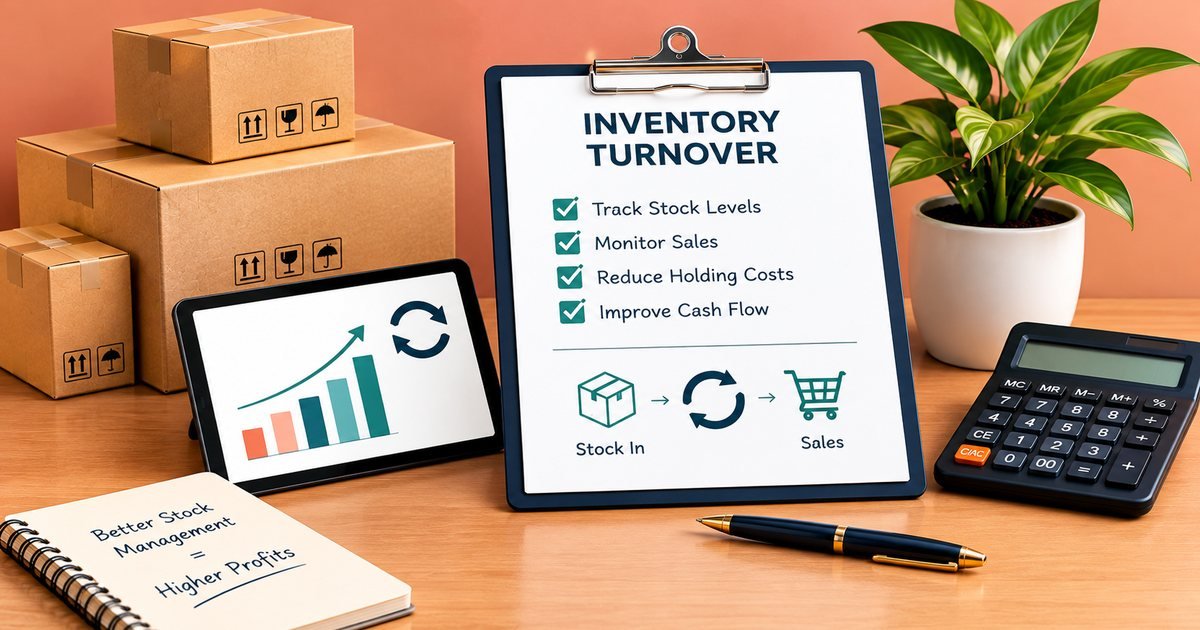
Stock that sits on a shelf is money that is not working. Inventory turnover measures how quickly you are turning that stock back into sales, and it is one of the most useful numbers a product business can track. It is simple to calculate, and the interesting part is what you do once you have it.
What inventory turnover measures
Inventory turnover is the cost of goods sold divided by your average inventory over the same period. The result says how many times you sell through, and replace, your stock. Suppose a shop has a cost of goods sold of 80,000 for the year. It started the year with 15,000 of stock and ended with 25,000, so average inventory is 20,000. Turnover is 80,000 ÷ 20,000 = 4. The shop turns its stock over four times a year.
Turning it into days
Divide 365 by the ratio to see how many days an item typically sits before it sells. A turnover of 4 means about 91 days. A shop with a turnover of 8 holds stock for roughly 46 days. Days are often easier to talk about than ratios, and they connect directly to cash: every day of stock is a day of money tied up. Our days inventory outstanding calculator does this conversion for you.
Why use cost of goods sold, not sales
Stock is valued at cost, so it should be compared with the cost of what you sold, not the price. Using sales would include your margin and make the ratio look better than it is. Make sure both numbers cover the same period, and if you use a quarter, multiply the ratio by four to compare it with an annual figure.
What counts as a good number
There is no universal answer. A grocer turns stock many times a year because food spoils, while a furniture shop or jeweller turns it much more slowly because the products are bigger, pricier and bought less often. Compare yourself with similar businesses and, above all, with your own history. If your turnover is falling while sales are flat, stock is building up somewhere.
When a high ratio is a warning
Faster is not always better. A very high turnover can mean you run out of stock and lose sales, or that you order so often in small quantities that your shipping and handling costs eat the saving. Check your fill rate alongside turnover. If customers cannot get what they want, a great ratio is not helping.
How to improve it
Start by finding out where the slow stock is. Many businesses find that a small group of products brings in most of the sales, while a long tail barely moves. Sort your products by sales and by value, and treat the groups differently.
For slow movers, options include bundling them with popular items, discounting before they become dead stock, returning them to the supplier if the terms allow, or simply not reordering. Put numbers on the decision: if an item has a 40% margin and a 20% discount takes it to 25%, you still recover cash that was doing nothing.
For the rest, order smaller quantities more often if your supplier and shipping costs allow it, improve your forecasts using last year's seasonality, and set reorder points so you buy when you need to rather than when it feels right. Our guide to reorder points and safety stock covers this.
A quick illustration of the cash effect
Take the shop above. If it can trim average inventory from 20,000 to 16,000 and still make the same sales, turnover rises from 4 to 5 and 4,000 of cash is released. That is money you could use to pay a supplier early, fund advertising or cover a quiet month, with no change in revenue.
Connect it to profit
Turnover tells you about speed, not profit. A fast-selling product with a thin margin may earn less than a slower one with a healthy margin. That is why many retailers also track gross margin return on inventory, or GMROI, which divides gross margin by average inventory cost. With a gross margin of 50,000 on 20,000 of average stock, GMROI is 2.5. Read more with our GMROI calculator.
Two products, two stories
The overall ratio can hide a lot. Imagine two products that each tie up 3,000 of average stock. Product A has a cost of goods sold of 24,000 a year, so it turns over 8 times and sits for about 46 days. Product B has a cost of goods sold of 6,000, so it turns over twice and sits for about 183 days. They use the same amount of cash, but B brings in a quarter of the sales. Unless B has a much higher margin, that cash would earn more invested in A.
A simple review routine
Once a month, list your products by turnover and look at the bottom of the list. For each slow item, ask three questions: is there a reason it should sell (a season coming, a promotion planned), can I return or reduce my next order, and should it be discounted now while it still has value? Stock loses value quietly, through damage, changing fashions and storage costs, and an early decision is nearly always cheaper than a late one.
Also watch for timing. A product may look slow because you bought a large batch just before the period ended. Look at turnover over several periods before you act on one number.
Measure it regularly
Track turnover monthly or quarterly, by category as well as in total, and watch the trend. Our inventory turnover calculator works it out from your COGS and average inventory. This guide is general information, so compare it with your own records and industry.