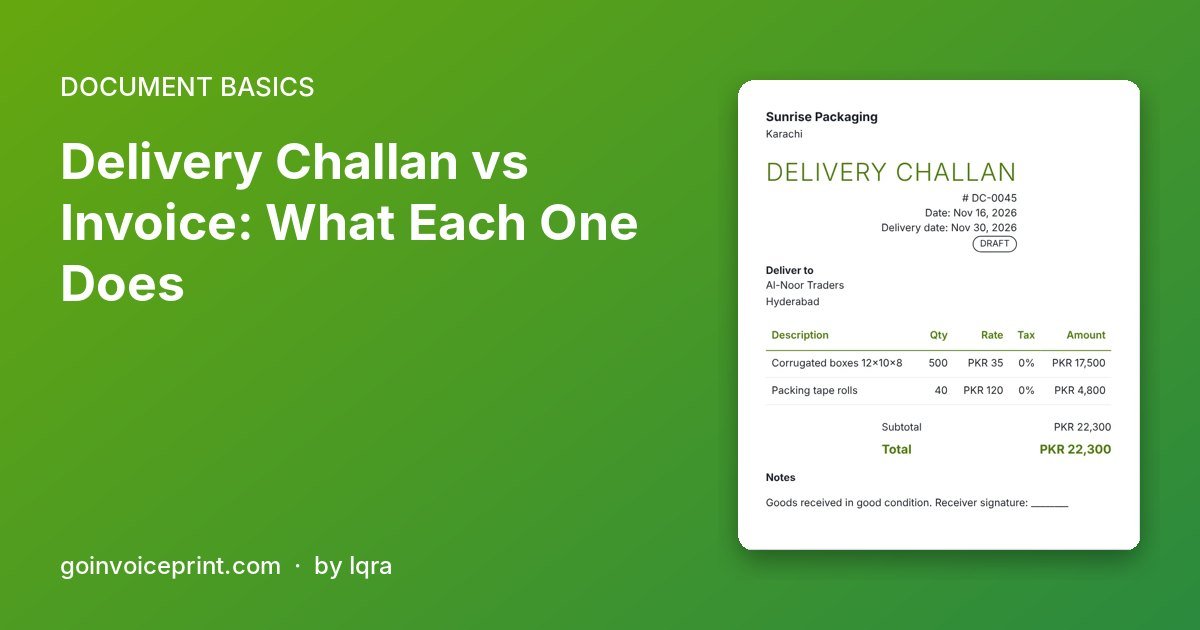
In shops and factories across Pakistan and India, goods rarely move without a delivery challan. Yet many small businesses are not sure whether a challan replaces an invoice, whether it needs prices, or when to send which one. The short answer: a delivery challan records the movement of goods, and an invoice records a sale and asks for payment. They do different jobs, and in many deliveries you need both.
- A delivery challan travels with the goods; an invoice asks for payment.
- A challan proves what was sent and received – it is not a bill.
- Use the challan number on the invoice so the two match.
- Get the receiver to sign the challan on delivery.
What a delivery challan is for
A delivery challan (sometimes called a delivery note) goes with the goods from the sender to the receiver. It lists what was sent and how much, so the receiver can check the delivery and sign for it. The signed copy comes back to the sender as proof of delivery. Challans are especially useful when:
- goods are delivered before the invoice is made, for example when the final quantity is checked on arrival;
- goods are sent for job work, repair or processing and will come back;
- goods are sent on approval or for an exhibition and may not be sold;
- a large order is delivered in several parts against one invoice.
What an invoice is for
An invoice is the bill. It says what was sold, at what price, the tax, the total and when payment is due. The buyer uses it to pay and to record the purchase; the seller uses it to record the sale and, where it applies, the tax charged.
| Delivery challan | Invoice | |
|---|---|---|
| Main purpose | Records goods moving and being received | Records a sale and asks for payment |
| When it is made | When goods leave | When the sale is made or the work is done |
| Prices | Optional – often shown as value for reference | Required |
| Payment | Does not ask for payment | Asks for payment by a due date |
| Signature | Receiver signs on delivery | Not usually signed by the buyer |
What to put on a delivery challan
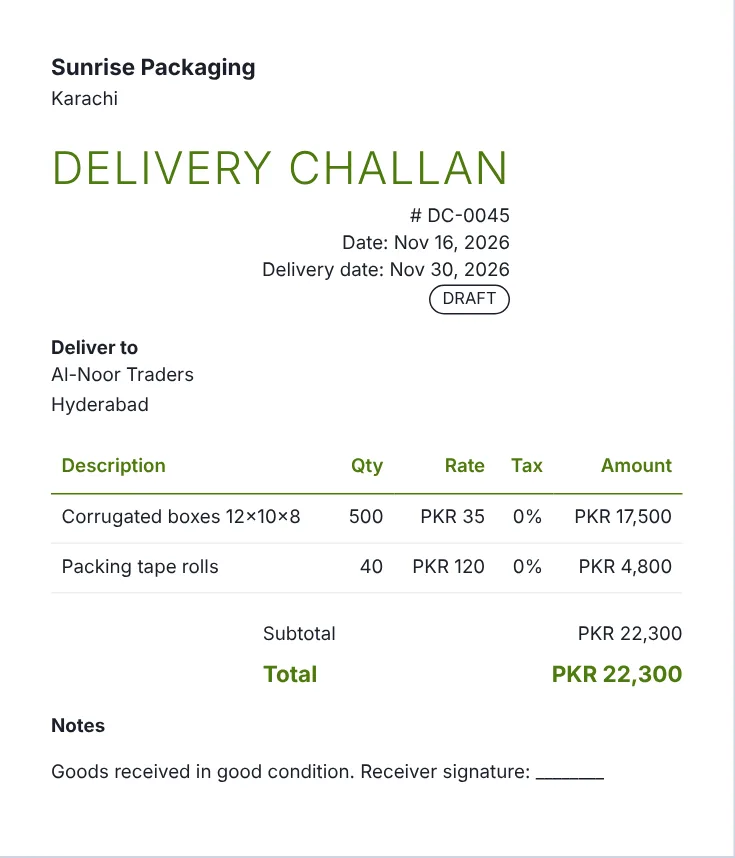
- A challan number and date – one series, never reused
- The sender’s name and address, and tax number if registered
- The receiver’s (consignee’s) name and delivery address
- A description and quantity of each item
- The value of the goods, where you need it for reference or for the rules that apply to you
- Vehicle number or transporter, if the goods travel by road
- A signature line for the person who receives the goods
A note for businesses registered for GST in India
India’s GST rules (Rule 55 of the CGST Rules) describe when goods may move on a delivery challan instead of a tax invoice – for example goods sent for job work, goods moved for reasons other than a sale, and liquid gas where the quantity is not known when it leaves. The rule also lists what the challan must contain and says it is made in three copies: original for the consignee, duplicate for the transporter and triplicate for the consigner. If you are GST-registered, check the current rules and e-way bill requirements for your situation.
How the two documents work together
A typical flow is: purchase order from the buyer → delivery challan with the goods → signed challan comes back → invoice sent for the quantity actually delivered. Write the challan number on the invoice (“Against DC-0045”) so anyone checking the records can match them. If part of the goods are rejected on delivery, note it on the challan and invoice only for what was accepted.
Returnable and non-returnable challans
Many businesses keep two kinds of challan. A returnable challan is used when the goods are expected to come back – tools lent to a site, items sent for repair, material sent for job work or samples sent on approval. A non-returnable challan is used when the goods are not coming back, usually because they are being sold and an invoice will follow. Writing “Returnable” or “Non-returnable” at the top saves arguments months later about where an item went.
An example from start to finish
| Step | Document | Who keeps it |
|---|---|---|
| Buyer orders 500 boxes and 40 rolls of tape | Purchase order | Buyer and seller |
| Goods leave the factory | Delivery challan DC-0045 (with the goods) | Driver, then buyer |
| Buyer checks and signs for the goods | Signed copy of DC-0045 | Seller, as proof of delivery |
| Seller bills for what was delivered | Invoice, “against DC-0045” | Buyer pays it; both keep a copy |
| Buyer pays | Receipt or bank record | Both |
When the delivery does not match the order
If the buyer receives fewer items than listed, or some are damaged, they should note it on the challan before signing (“480 received, 20 damaged”). The seller then invoices only for what was accepted, or issues a credit note if the invoice has already gone out. A signed challan with notes is the easiest way to settle any dispute about quantities.
Frequently asked questions
Can a delivery challan be used instead of an invoice?
No. A challan records the delivery; it does not ask for payment. If goods are sold, send an invoice as well.
Does a delivery challan need prices?
Not always. Many challans show only quantities, while others show the value for reference or because local tax rules ask for it.
Who signs a delivery challan?
The person who receives the goods signs to confirm the delivery, and the signed copy is kept by the sender as proof.
What is the difference between a delivery challan and a packing slip?
They are very similar. A packing slip lists what is inside a parcel; a delivery challan is used more for business deliveries and often carries a receiver signature.
How many copies of a delivery challan should I make?
Usually at least two – one for the receiver and one signed copy for you. Under India’s GST rules a challan is made in three copies.