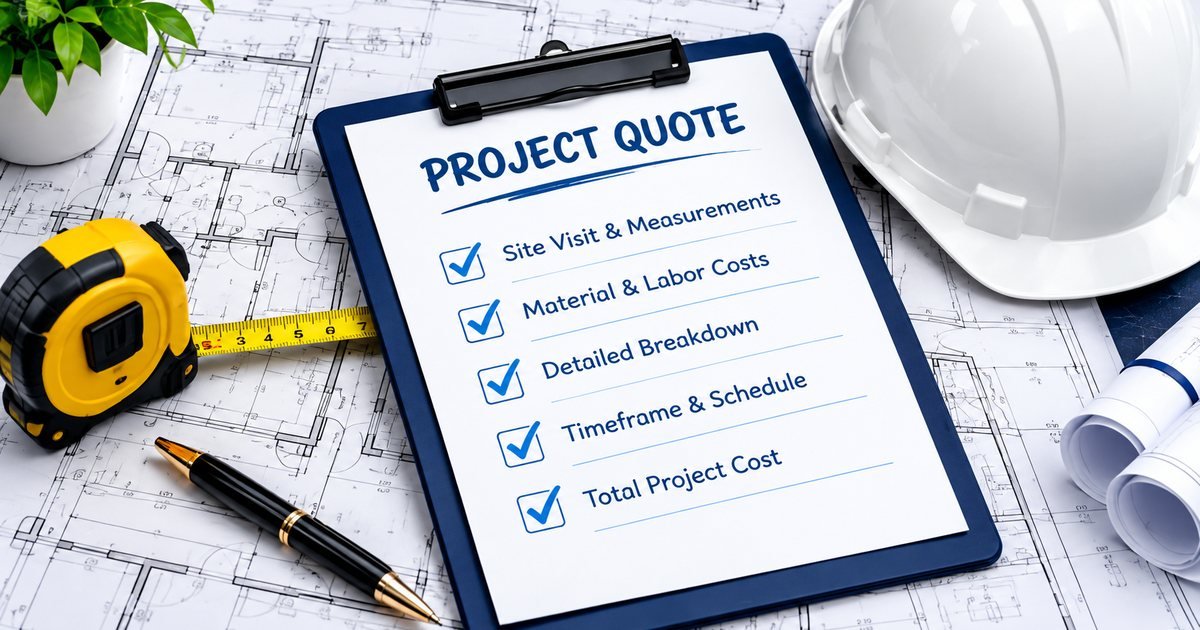
Quoting a project is partly arithmetic and partly judgement. Quote too low and you do the work at a loss. Quote too high without explaining why and you lose it to someone who sounded more confident. A good quote comes from a clear scope, honest estimates and a method you can repeat. Here is one.
Start with the scope
Before any numbers, write down what the client wants and what they will receive. List the deliverables, the number of revisions included, what you need from the client, and what is not covered. A scope written in a paragraph or a short list prevents most disagreements. If you cannot describe the scope clearly, you cannot price it reliably, and that is the moment to ask the client more questions.
Break the work into tasks
Small tasks are far easier to estimate than one large project. For a website, the list might be discovery, design, build, content entry, testing and project management. Estimate each one separately, then add them up. Include the tasks that are easy to forget: meetings, emails, revisions, handover and admin.
Estimate the hours honestly
Use your past projects as a guide, not your hopes. How long did similar tasks really take? Suppose the estimates are 6 hours for discovery, 18 for design, 30 for building, 8 for content, 6 for testing and 7 for project management. That is 75 hours. At a rate of 60 an hour, labour comes to 4,500. If you are not sure how to set the rate, see our hourly rate guide.
Add direct costs
Include anything you must pay for to deliver the project: licences, stock images, hosting for the build, travel, subcontractors. Say these come to 300. Direct cost is now 4,800.
Add overhead and profit
Your overheads, such as software, insurance and admin, need to be covered by every project, and so does your profit. If you add 10% for overhead, the figure becomes 5,280. A 20% profit on top gives 6,336. This is the method used by our project cost quote calculator: (labour + materials) × (1 + overhead) × (1 + profit). Note that a 20% profit added to cost is a markup, not a margin, which is roughly 16.7% of the final price. Our guide on markup vs margin explains the difference.
Allow for the unknown
If the project has uncertain parts, build in a buffer. One approach is to add 10% to the hours. That makes 82.5 hours, so labour is 4,950. With 300 of direct costs, that is 5,250, then 5,775 with overhead and 6,930 with profit. The buffer lifts the price by about 600, which is the cost of not being surprised. Alternatively, keep the price lower but state clearly which assumptions it rests on, and say what happens if they prove wrong.
Present the quote clearly
Show the price, what it includes and the key assumptions: how many revisions, who supplies content, the timeline and what is excluded. Add the payment schedule and the date until which the quote is valid. A client who understands what they are paying for finds it much easier to say yes. For the wording and structure, see estimate vs quote.
Offer options
Instead of a single price, consider offering two or three packages: a basic version, a standard one and a premium one with extras. It gives the client a choice and moves the conversation from "should I hire you?" to "which option?". Make sure each package is genuinely profitable, since some clients will always choose the cheapest.
Set the payment schedule
Do not leave payment to the end. Propose a deposit and milestone payments tied to deliverables. On a 6,336 quote, 30% on acceptance is 1,900.80, which you might round to 1,900 or state as a percentage. Our guide on deposits and milestone billing shows how.
Handle changes
Projects change. Agree in the quote how extra requests are handled: priced separately, approved in writing, and added to the schedule. A short "change request" note with the extra cost and a yes from the client protects both sides.
Check your quote against reality
After every project, compare the hours you estimated with those you actually used. Over a few projects, you will see where you tend to underestimate and can correct your method. That feedback loop is what turns quoting from a guess into a skill.
Mistakes that cost money
Most underpriced projects share the same few causes. People price only the visible tasks and forget project management, meetings and revisions. They use best-case hours instead of the time similar work really took. They leave the assumptions unstated, so every misunderstanding becomes their cost. They quote without a validity date, then discover prices have changed. They discount to win the work and still deliver the full scope. And they never record the hours actually used, so they repeat the same errors. Fixing even two of these will improve your results.
Put it into practice
Try the calculator, then present the result with our estimate generator. This guide is general information, so adapt the percentages and rates to your own business.