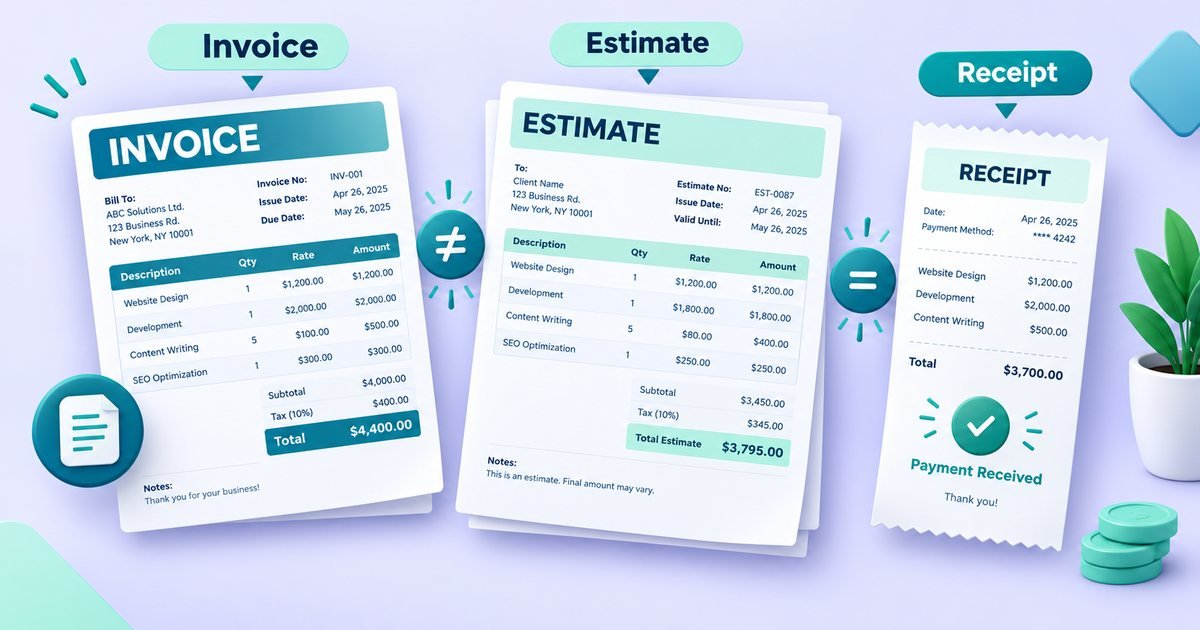
Clients rarely care whether you call a document an estimate or a quote. You should, because the choice decides who pays when the job turns out to be bigger than expected. Our guide on quotes and invoices covers how the documents fit together. This one is about the pricing decision behind them.
It comes down to who carries the risk
With a fixed-price quote, you promise a price, and if the work takes longer than you thought, the extra time is your cost. With an estimate, you give your best judgement and the client accepts that the final figure may move. With hourly billing, the client carries most of the uncertainty. None of these is wrong. The right one depends on how well you can predict the work.
Three ways to price a job
A fixed-price quote suits work you can describe precisely and have done before: a logo with a set number of concepts and two revision rounds, painting a room of known size, a standard audit. Its protection is the scope. List what is included and what is not, and limit the revisions.
A non-binding estimate suits work with unknowns: renovation jobs that may uncover hidden problems, debugging, research. A range is more honest than a single number. For example, "between 1,800 and 2,400, depending on the condition of the existing pipework" tells the client what could change the price.
A cap, or "not to exceed", is a middle path. You bill by the hour, but you promise not to go above an agreed amount without the client's written approval. Clients like the certainty, and you are not working for free once the cap is reached.
Example wording
Fixed price: "Fixed price of 2,400 for the work described above. Valid until 31 October."
Estimate: "Estimated total 1,800 to 2,400. The final amount depends on the condition of the existing pipework. We will contact you before the total goes above 2,400."
Cap: "Billed at 60 per hour and not to exceed 2,400 without your written approval."
What happens when the job grows
Take the bathroom repair estimated at 1,800 to 2,400. When the wall is opened, a corroded pipe turns up, and replacing it adds 650. The right move is to stop, tell the client what you found, give the extra cost and get a yes before carrying on. An approval by email is enough. Doing the work first and explaining afterwards is how disputes start, even when the extra work was needed.
Whose mistake is it?
On a fixed-price quote, if you simply underestimated the time, that is your cost. If the client changed the brief or added requests, that is new work and should be priced. Writing down the scope at the start makes this conversation much easier, because you can point to what was agreed rather than argue from memory.
Pricing in some contingency
For uncertain work, many people add a buffer to a fixed price, commonly 10% or more depending on how uncertain the job is. The alternative is to give a range, or an estimate with a cap. Whichever you choose, make the buffer a conscious decision. Quoting low to win the job and hoping nothing goes wrong tends to end badly.
Check the local rules
Some places have specific rules for estimates in certain trades, particularly repair and building work for consumers, such as limits on how far the final bill may exceed an estimate without the customer's agreement. These rules vary by country and region, so look up what applies to you.
How to decide
Ask yourself three questions. Can I describe the scope in a paragraph? Do I know the hours to within roughly 15%? Is the client likely to change their mind? If the answer is yes, yes and no, a fixed-price quote is a good fit. If any answer is uncertain, use an estimate range or a capped hourly price. And when you are not sure, saying so openly usually earns more trust than a confident number you cannot stand behind.
Three short scenarios
A five-page website. The pages, features and number of revisions are clear, and you have built similar sites before. A fixed-price quote fits. Spell out what counts as a revision, and price anything beyond the five pages separately.
Cleaning up a client's messy data. Nobody knows how bad it is until someone opens the files. An estimate with a range works better here, ideally with a checkpoint: "After the first five hours I will report back on what I found and confirm the likely total." The client gets early warning, and you are not trapped in a price you could not have predicted.
Photographing an event. The date is fixed, but the length of the day can stretch. Hourly billing with a cap, such as "up to eight hours, with additional time at the same hourly rate if you agree in advance", keeps both sides comfortable.
Keep a paper trail
Whichever model you choose, keep the quote or estimate, the client's acceptance and any later change approvals together in one folder, or in one email thread. When the final invoice arrives, it should be easy to see how it relates to what was agreed, and to point to the line in the quote that explains any difference.
Create yours
You can write either kind with our free estimate generator, then convert the accepted job into an invoice with the invoice generator. To get paid promptly afterwards, see how to get paid faster. This guide is general information, not legal advice.