If your business is registered for VAT in the UK, the invoices you send to other VAT-registered businesses are not just bills – your customer needs them to reclaim the VAT they paid you. That is why HMRC is specific about what a VAT invoice must show. This guide lists the requirements in plain English. It is based on HMRC’s guidance on GOV.UK; always check there for the latest rules.
- Only VAT-registered businesses can charge VAT and issue VAT invoices.
- A full VAT invoice needs your VAT number, a unique number, the tax point and the VAT for each rate.
- A simplified invoice is allowed when the total including VAT is £250 or less.
- Keep VAT invoices for at least six years.
Important: if you are not registered for VAT, you must not charge VAT or show a VAT number. Send a normal invoice without a VAT line.
What a full VAT invoice must show
- A unique invoice number that follows on from your previous invoices.
- The date of the invoice.
- The time of supply (tax point), if it is different from the invoice date.
- Your business name and address and your VAT registration number.
- Your customer’s name or trading name, and address.
- A description that identifies the goods or services.
- For each item: the quantity or extent, the unit price excluding VAT and the VAT rate.
- The total amount excluding VAT.
- The rate of any discount per item.
- The total amount of VAT charged, in sterling.
If an invoice includes items at different VAT rates – for example 20% and 5% – show the net amount and the VAT for each rate separately. If you invoice in another currency, the VAT total must still be shown in pounds sterling.
The current VAT rates
| Rate | % | Examples |
|---|---|---|
| Standard | 20% | Most goods and services |
| Reduced | 5% | Some goods and services, such as domestic energy and children’s car seats |
| Zero | 0% | Zero-rated goods such as most food and children’s clothes |
Rates were checked in November 2026. Which rate applies to a particular item depends on HMRC’s rules for that item.
Simplified VAT invoices
If the total of a supply, including VAT, is £250 or less, you can issue a simplified invoice. It only needs your business name, address and VAT number, the time of supply, a description of the goods or services, the total payable including VAT and the VAT rate for each item. You cannot include exempt supplies on a simplified invoice. Retailers can also use a “modified” invoice showing VAT-inclusive amounts, if the customer agrees.
Timing and records
The tax point matters because it decides which VAT return the sale belongs to. If you issue the VAT invoice within 14 days of the basic tax point (usually the date of supply), the invoice date normally becomes the tax point. Keep copies of every VAT invoice you issue and receive – including cancelled ones – for at least six years. Under Making Tax Digital, VAT records must be kept digitally.
Common mistakes
- Charging VAT before you are registered, or showing an old or wrong VAT number.
- Reusing or skipping invoice numbers without a record of why.
- Showing only a VAT-inclusive total on a full invoice instead of the net amount and the VAT.
- Editing an invoice that has already been sent instead of issuing a credit note and a new invoice.
Example: one invoice, two VAT rates
When an invoice has items at different rates, show the net amount and the VAT for each rate. For example, a shop selling a child’s car seat (5%) and a pram cover (20%) to a business customer:
| Item | Qty | Unit price (ex VAT) | VAT rate | Net | VAT |
|---|---|---|---|---|---|
| Child car seat | 2 | £80.00 | 5% | £160.00 | £8.00 |
| Pram rain cover | 2 | £15.00 | 20% | £30.00 | £6.00 |
| Totals | £190.00 | £14.00 | |||
The amount due is £204.00. Showing the VAT for each rate lets your customer reclaim exactly the right amount.
Pro forma invoices and credit notes
A pro forma invoice is an offer or a request for payment in advance – it is not a VAT invoice, and your customer cannot use it to reclaim VAT. Mark it clearly, for example “This is not a VAT invoice”, and issue a proper VAT invoice once the supply is made or payment is received. If you need to reduce or cancel an invoice, issue a credit note that refers to the original invoice and shows the same kind of detail, including the VAT being credited.
A quick checklist before you send
- Is my VAT number on the invoice and correct?
- Does the invoice number follow on from the last one?
- Is each item’s VAT rate right, and is the VAT shown for each rate?
- Is the VAT total shown in pounds sterling?
- Does the customer’s name and address match their details?
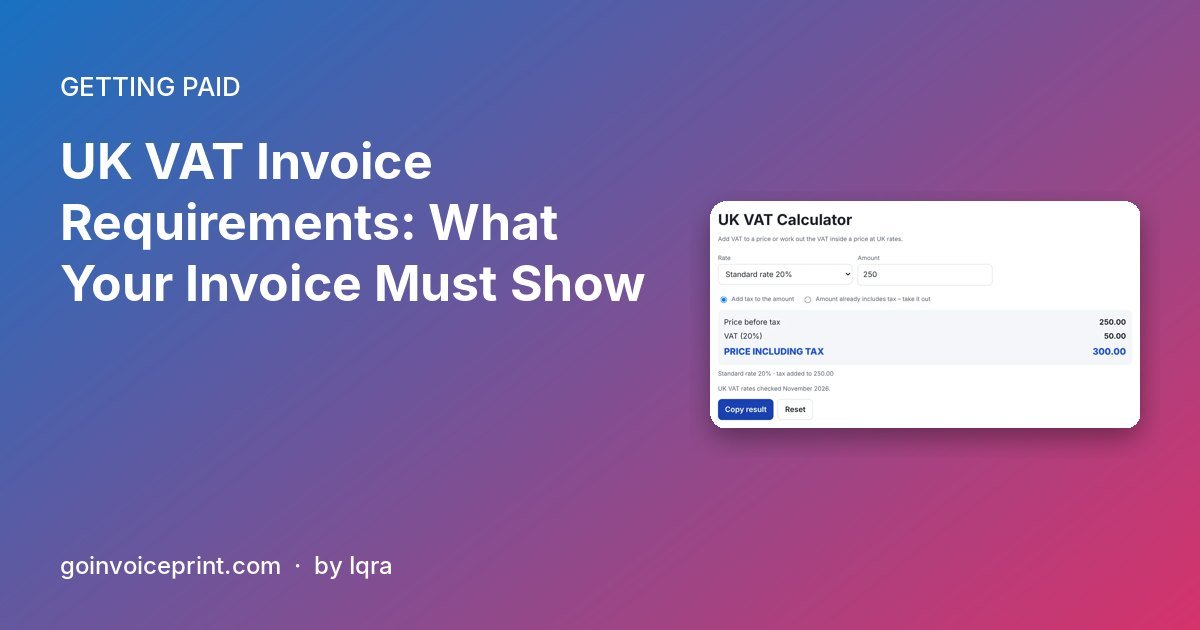
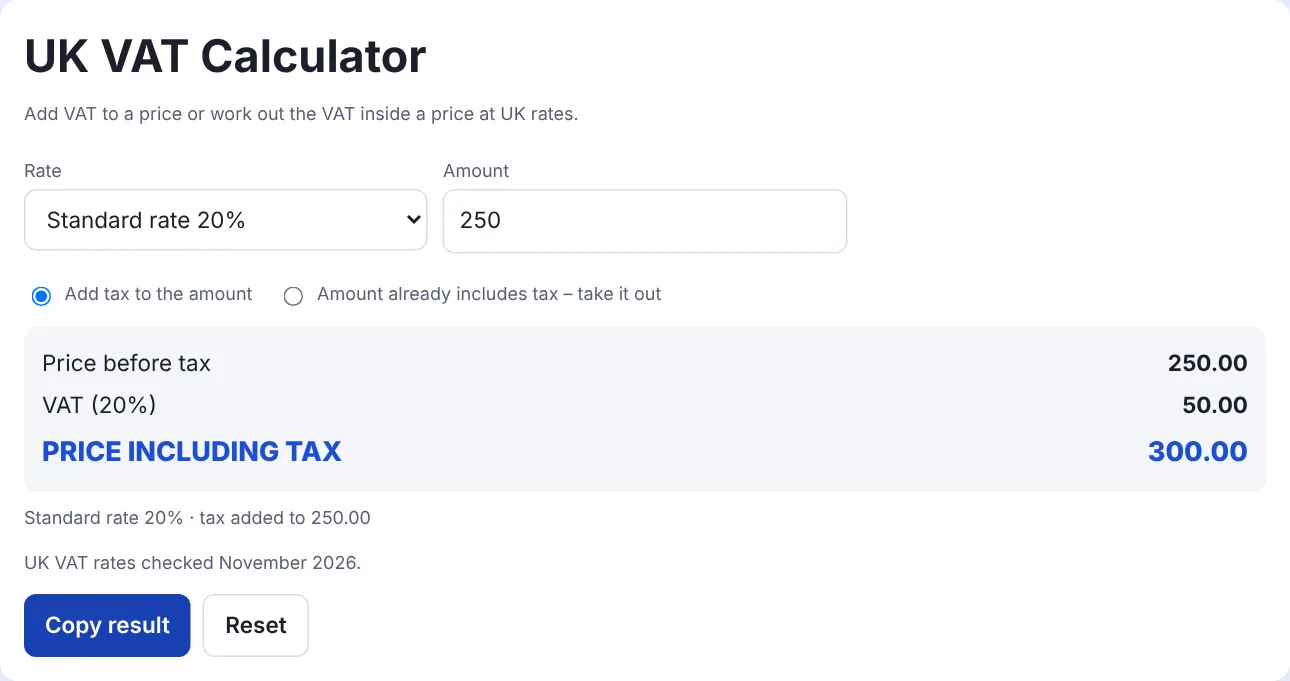
You can work out the VAT on any amount with the UK VAT calculator and then make the invoice itself with the free invoice generator.
Frequently asked questions
Do I need a VAT number on my invoice?
Only if you are registered for VAT. If you are registered, your VAT registration number must be on every VAT invoice.
What is a simplified VAT invoice?
A shorter invoice that can be used when the total, including VAT, is £250 or less. It still needs your VAT number, the tax point, a description, the total and the VAT rate.
Can I issue a VAT invoice in euros or dollars?
Yes, but the total VAT must also be shown in pounds sterling.
How long must I keep VAT invoices?
At least six years, including invoices you received and any you cancelled.
How do I correct a VAT invoice?
Do not edit the original. Issue a credit note for the wrong invoice and then send a new, correct invoice with a new number.