Invoices and supplier contracts are full of short codes like 2/10 Net 30, Net 30 EOM, 30-60-90 or 30 days PDC. They look technical, but each one simply answers two questions: when must the invoice be paid, and is there a discount for paying early? This guide explains every common term with a worked example, and gives you wording you can copy onto your own invoices.
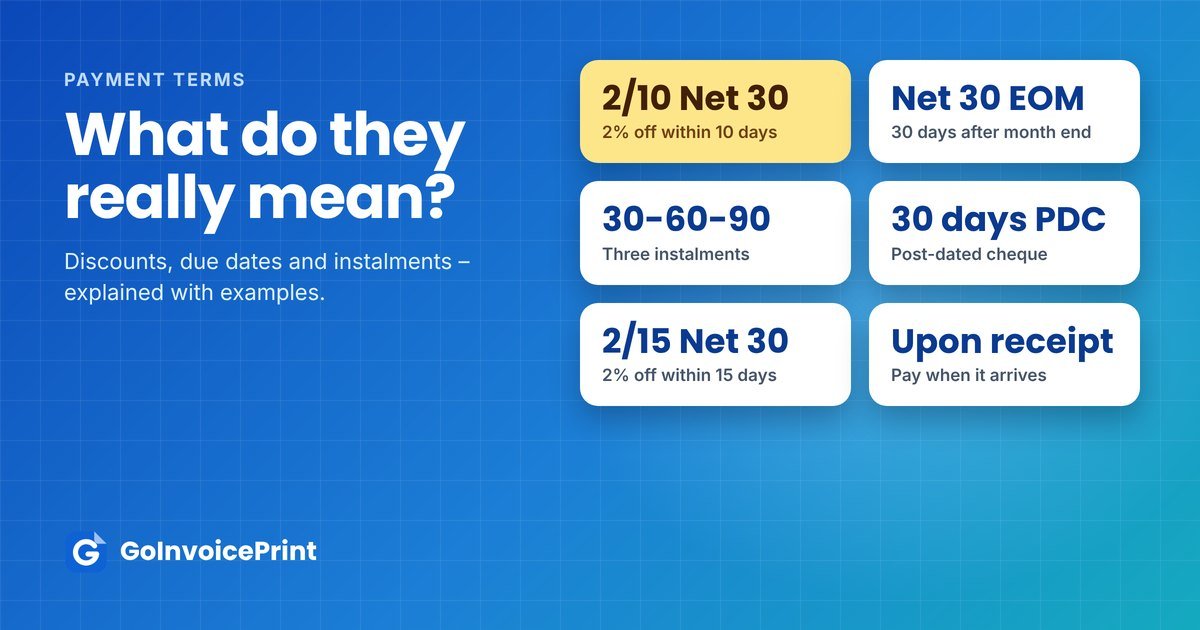
- 2/10 Net 30 means 2% off if paid within 10 days, otherwise the full amount within 30 days.
- Net 30 EOM and “30 days net monthly” usually count 30 days from the end of the invoice month.
- 30-60-90 is either three instalments or an ageing report of overdue invoices.
- Write the exact due date on every invoice, not just the code.
Payment terms at a glance
| Term | What it means | Example (invoice dated 1 March) |
|---|---|---|
| Due on receipt | Pay as soon as the invoice arrives | Due 1 March, or the day it is received |
| Net 30 | Full amount within 30 days of the invoice date | Due 31 March |
| 2/10 Net 30 | 2% off if paid within 10 days, otherwise full amount within 30 | Pay 98% by 11 March, or 100% by 31 March |
| 2/15 Net 30 | 2% off if paid within 15 days, otherwise full amount within 30 | Pay 98% by 16 March, or 100% by 31 March |
| Net 30 EOM | 30 days after the end of the invoice month | Due 30 April |
| 30 days net monthly | Usually the same as Net 30 EOM | Due 30 April |
| 30 days upon receipt of invoice | 30 days counted from the day the customer receives the invoice | Received 3 March, due 2 April |
| 30-60-90 | Paid in three parts at 30, 60 and 90 days (or an ageing report) | One third due 31 March, 30 April and 30 May |
| 30 days PDC | Paid with a post-dated cheque dated 30 days ahead | Cheque dated 31 March, handed over at delivery |
2/10 Net 30 and 2/15 Net 30 explained
These are early payment discount terms. The first number is the discount percentage, the second is the number of days the discount is available, and “Net 30” is the final deadline for the full amount.
Worked example: you send an invoice for 1,000 on 1 March with terms 2/15 Net 30.
- If the customer pays by 16 March, they may deduct 2% and pay 980.
- If they pay between 17 and 31 March, they pay the full 1,000.
- After 31 March the invoice is overdue, and any late-payment terms apply.
With 2/10 Net 30 the discount window is 10 days instead of 15, so the 980 must be paid by 11 March.
Is the early payment discount worth it?
For the buyer it usually is. Paying 20 days early to save 2% (2/10 Net 30) works out at roughly 37% a year, and 2/15 Net 30 at roughly 50% a year – far more than most savings accounts or loans cost. For the seller, it means giving away 2% of the invoice in exchange for faster cash. Offer it only if quicker payment really matters to you, and remember that the discount is lost on every invoice that is paid early anyway.
Net 30 EOM and “30 days net monthly”
EOM means end of month. With Net 30 EOM the 30 days start counting from the last day of the month the invoice is dated, not from the invoice date. So every invoice dated in March – whether on 2 March or 29 March – is due on 30 April.
The phrase “30 days net monthly” (or “30 days end of month”) is normally used in the same way, especially in the UK and in supplier accounts that are paid in one monthly run. Because the wording is not standard everywhere, it is safer to write the exact rule on your invoice, for example: “Payment due 30 days after the end of the month of invoice.”
What does 30-60-90 mean?
You will see “30-60-90” used in two different ways:
- Instalment payment terms. The total is paid in three equal parts, 30, 60 and 90 days after the invoice or delivery date. On an invoice for 3,000 dated 1 March, 1,000 is due on 31 March, 1,000 on 30 April and 1,000 on 30 May. This is common for larger orders, equipment and projects.
- An accounts receivable ageing report. Here 30, 60 and 90 are buckets that show how overdue your unpaid invoices are: up to 30 days late, 31–60 days late and 61–90 days late (often with a “90+” column). It is a way of tracking late payers, not a payment term.
If you agree 30-60-90 instalments, list each instalment with its date and amount on the invoice so there is no doubt.
What does 30 days PDC mean?
PDC stands for post-dated cheque. With “30 days PDC” the buyer hands over a cheque when the goods are delivered, but the cheque is dated 30 days later, so it cannot be cashed until then. These terms are common in Pakistan, India, the UAE and other countries where cheques are still widely used in business.
- Record the cheque number, bank and date on your copy of the invoice or receipt.
- Do not deposit the cheque before its date – the bank will not pay it early.
- Agree in writing what happens if the cheque is returned unpaid. Rules on bounced cheques differ from country to country.
“Due upon receipt” vs “30 days upon receipt of invoice”
Due upon receipt means the invoice should be paid as soon as it arrives. 30 days upon receipt of invoice means the customer has 30 days, counted from the day they receive the invoice rather than the date printed on it. Because the day of receipt can be argued about, many businesses prefer Net 30 (from the invoice date) and send invoices by email so they arrive the same day.
Payment terms wording you can copy
- “Payment is due within 30 days of the invoice date (Net 30).”
- “Terms: 2/10 Net 30. A 2% discount applies if paid within 10 days; otherwise the full amount is due within 30 days.”
- “Payment is due 30 days after the end of the month of invoice (Net 30 EOM).”
- “Payment is due upon receipt of this invoice.”
- “Payment in three equal instalments due 30, 60 and 90 days from the invoice date.”
- “Payment by post-dated cheque dated 30 days from delivery.”
- “50% advance on order confirmation, balance due on delivery.”
- “Invoices unpaid after the due date may be charged a late fee of 1.5% per month.”
Calendar days or business days?
Unless your terms say otherwise, payment terms are counted in calendar days, including weekends and holidays. If the due date falls on a weekend, many customers pay on the next working day – if that matters to you, say “on or before” the date. Writing the actual due date on the invoice, as well as the term, removes any doubt.
For a wider look at choosing terms, see Invoice Payment Terms Explained and How to Get Paid Faster. This guide is general information, not legal or financial advice.
How to do it with GoInvoicePrint
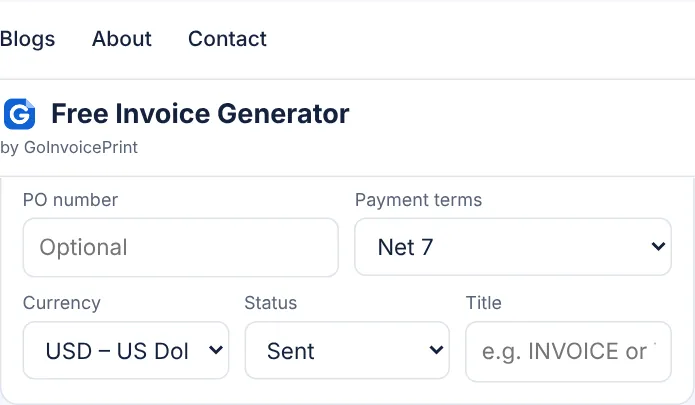
You can do this in a couple of minutes with our free Invoice Generator. No download is needed and it works on your phone too.
- Open the free Invoice Generator and fill in your details and the client’s.
- In Invoice information, choose your terms from the Payment terms menu – the due date is worked out for you.
- For discounts, instalments or PDC, write the exact wording from this guide in Terms.
- Check the preview shows the terms and due date clearly, then Download PDF or email it.
Frequently asked questions
What does 2/10 Net 30 mean?
The customer can take a 2% discount if they pay within 10 days of the invoice date. Otherwise the full amount is due within 30 days.
What does 2/15 Net 30 mean?
A 2% discount is allowed if the invoice is paid within 15 days; otherwise the full amount is due within 30 days. On a 1,000 invoice dated 1 March, that is 980 by 16 March or 1,000 by 31 March.
What are 30 60 90 payment terms?
Usually the total is paid in three equal instalments, 30, 60 and 90 days after the invoice or delivery date. In accounting, 30-60-90 can also mean the columns of an ageing report that show how overdue invoices are.
What does 30 days PDC mean?
PDC means post-dated cheque. The buyer gives a cheque dated 30 days in the future, which the seller can deposit only on or after that date.